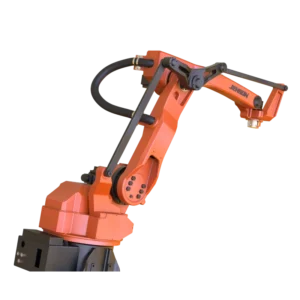
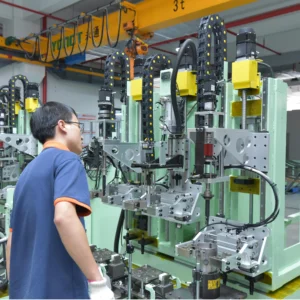
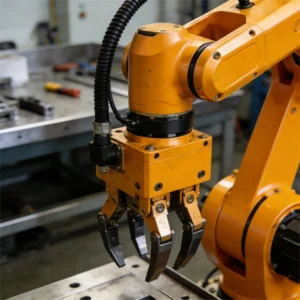
In the rapidly evolving landscape of industrial automation, understanding the diverse types of industrial robots is critical for manufacturers seeking efficiency, precision, and scalability. From traditional six-axis systems to cutting-edge collaborative robots, each type serves unique applications across various industries, including automotive, electronics, healthcare, and logistics.
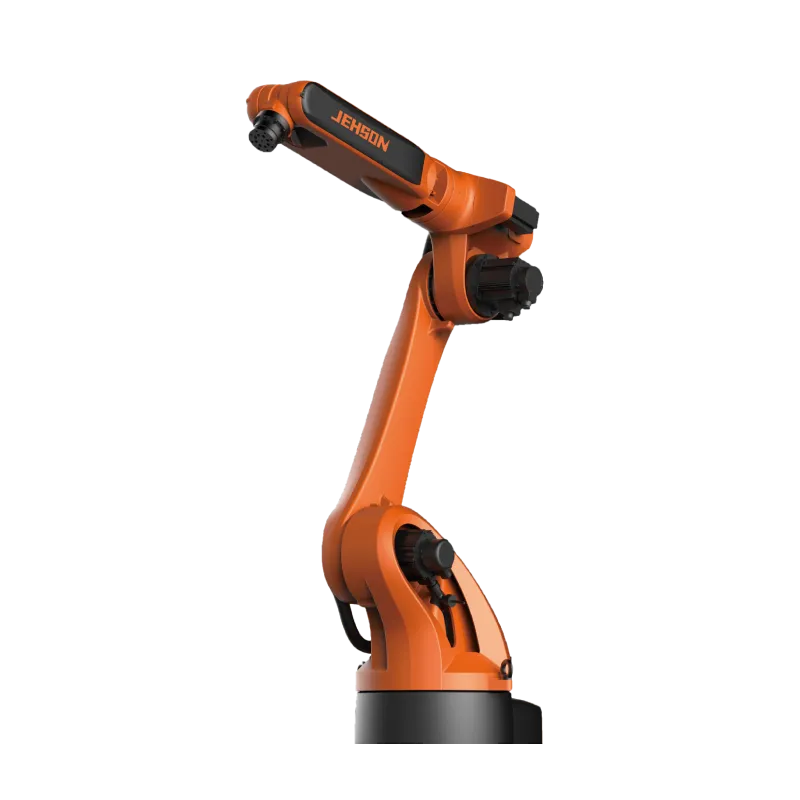
Articulated Robots (Jointed-Arm Robots)
Articulated robots, the most prevalent type, resemble human arms with multiple rotary joints, typically 4 axes–6 axes. Their flexibility enables complex movements, making them ideal for tasks that require dexterity and reach.
Key Features
- Structure: Rotational joints enabling multi-directional motion.
- Work Envelope: Spherical or cylindrical, depending on joint configuration.
- Payload Capacity: Varies widely (from 1 kg to over 1,000 kg).
Applications
- Welding: Arc welding, spot welding in the automotive and aerospace industries.
- Material Handling: Loading/unloading machines, palletizing goods.
- Assembly: Electronics, automotive parts assembly.
- Painting/Coating: Spray painting in automotive body shops.
Advantages
- Exceptional versatility and adaptability.
- High precision for intricate tasks.

Cartesian Robots (Gantry Robots)
Cartesian robots move along linear axes (X, Y, Z) on gantry structures, offering simplicity, rigidity, and precise positioning. They are often used in heavy-duty or large-scale applications.
Key Features
- Structure: Three prismatic joints for linear movement along orthogonal axes.
- Work Envelope: Rectangular or cubic space.
- Precision: High repeatability (±0.02 mm).
Applications
- 3D Printing: Large-scale additive manufacturing.
- Machine Tending: Loading CNC machines and injection molding tools.
- Material Handling: Transporting heavy payloads in warehouses.
- Electronics Assembly: Placing micro-components with pinpoint accuracy.
Advantages
- Cost-effective and easy to program.
- Customizable stroke lengths and payloads.

SCARA Robots (Selective Compliance Assembly Robot Arm)
SCARA robots combine vertical rigidity with horizontal flexibility. Their compliant motion in the Z-axis simplifies pick-and-place operations, excelling in assembly and pick-and-place tasks. Their compact design makes them ideal for confined spaces.
Key Features
- Structure: Two parallel rotary joints (for horizontal movement) and one linear joint (vertical).
- Work Envelope: Cylindrical or dome-shaped.
- Speed: Fast cycle times (up to 100 picks per minute).
Applications
- Electronics Manufacturing: PCB assembly, component placement.
- Food Packaging: Sorting and boxing snacks, beverages.
- Pharmaceuticals: Bottle capping and labeling.
- Automotive: Small-part assembly (e.g., screws, sensors).
Advantages
- High-speed operation with minimal errors.
- Compact footprint for space-constrained environments.

Delta Robots (Parallel-Link Robots)
Delta robots employ a triangular parallelogram design with three lightweight arms connected to a central platform. This configuration enables lightning-fast movements and exceptional acceleration, making them ideal for repetitive, high-speed tasks.
Key Features
- Structure: Three arms forming a triangular parallelogram.
- Work Envelope: Dome-shaped coverage above the base.
- Payload: Lightweight (1–3 kg), but extremely fast (accelerations up to 10 g).
Applications
- Food Processing: Sorting fruits, vegetables, and baked goods.
- Pharmaceuticals: Packaging pills and capsules.
- E-commerce: Fulfillment center order picking.
- Electronics: Placing tiny components on circuit boards.
Advantages
- Exceptional acceleration and deceleration capabilities.
- Reduced cycle times for repetitive tasks.

Collaborative Robots (Cobots)
Cobots are designed to work safely alongside humans without safety barriers. Equipped with force sensors and rounded edges, they prioritize operator safety while enhancing productivity through shared workspace collaboration.
Key Features
Payload Capacity: 3–35 kg.
Speed Limitations: Slower operation (max 2 m/s) to ensure safety.
Programming: User-friendly interfaces (e.g., hand-guided teaching) eliminate coding expertise.
Applications
Light assembly, quality inspection, packaging, and machine tending
Advantages
Reduced risk of injury, lower programming barriers, and scalability for SMEs.
How to Choose the Right Industrial Robot?
Selecting the optimal industrial robot hinges on aligning technical specifications with operational goals. By prioritizing these factors, manufacturers can enhance throughput, reduce costs, and achieve long-term competitiveness:
Task Requirements
- Payload Capacity: Heavy-duty tasks like metal stamping demand six-axis or Cartesian robots, while delicate operations like electronics assembly favor SCARAs or cobots.
- Reach Radius: Determine workspace size, and precision micron-level accuracy for devices vs. general tolerance for packaging.
Environmental Factors
Hazardous conditions, such as welding sparks, chemical exposure, necessitate explosion-proof cobots.
Integration Compatibility
Modular designs or AI-enabled cobots future-proof operations for Industry 4.0 upgrades.
The Takeaway
Industrial robots are catalysts for operational excellence, each type addresses specific challenges. As industrial robots become increasingly widespread, the future will see the realization of AI-driven automation and deeper integration. By embracing these technologies, businesses can unlock unprecedented efficiency, safety, and competitiveness in the global marketplace.
Jehson specializes in automated manufacturing, and we establish streamlined production through high-precision manufacturing methodologies. Spanning the spectrum from individual machine automation to comprehensive production line integration, our firm delivers customized factory automation solutions.