In today’s fast-paced manufacturing landscape, efficiency, precision, and adaptability are non-negotiable. Enter robotic work cells, self-contained units where robots, tools, and machinery collaborate to automate complex tasks. These systems are revolutionizing industries from automotive to electronics, offering unmatched productivity and consistency.
What Is a Robotic Work Cell?
A robotic work cell is a dedicated area equipped with robots, peripherals, and safety systems, which are all designed to execute specific tasks autonomously. Unlike standalone robots, work cells integrate hardware (robots, conveyors, and sensors) and software (controllers and programming interfaces) to form an efficient, cohesive unit. Imagine a mini-factory within your facility, capable of handling processes such as welding, assembly, inspection, and packaging.
Key features:
- Autonomy: Runs pre-programmed tasks with minimal human intervention.
- Modularity: Can be scaled or reconfigured for evolving production needs.
- Safety: Equipped with safeguards (light curtains, emergency stops) to protect workers.
Components of a Robotic Work Cell
Every robotic work cell is built around these core elements:
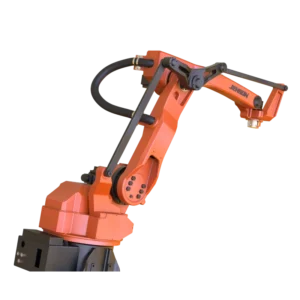
- Industrial robot: The centrepiece is chosen based on payload, reach, and precision. Options include articulated robots, such as 4-axis or 6-axis arms, which are ideal for complex movements, and SCARA robots, which are perfect for precise horizontal assembly.
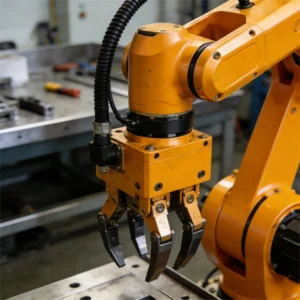
- End-Effector: The tool attached to the robot’s arm—grippers, welders, dispensers, or custom tools tailored to the task.
- Controller: The “brain” that dictates movements and synchronizes operations. Modern controllers leverage AI for real-time adjustments.
- Safety Features: Light curtains, safety scanners, and emergency stops ensure compliance with industry standards.
- Material Handling Systems: Conveyors, robotic arms, or automated guided vehicles (AGVs) for transporting parts in/out of the cell.
- Sensors/Vision Systems: Cameras and sensors enable quality checks, part alignment, and adaptive workflows.

Types of Robotic Work Cells
Robotic work cells are not one-size-fits-all; they vary based on application and environment. Here’s how they adapt to diverse needs:
Single-Station Cells: Focus on one task (e.g., welding, painting) in a compact setup. Ideal for small-batch production.
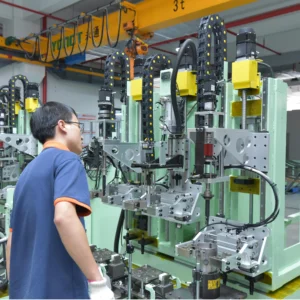
Multi-Station Cells: Combine multiple processes in a single enclosure, such as Jehson’s Multi-Station Side Punching Machine, streamlining workflows for high-volume tasks.
Collaborative Cells: Feature cobots, enabling humans and robots to work side-by-side safely. Perfect for tasks requiring flexibility and adaptability.
Mobile Cells: Mounted on wheeled platforms, these cells can relocate between stations to address dynamic production demands.
Custom Cells: Tailored to unique applications (e.g., aerospace part fabrication or medical device assembly).
Mitigating Risks
Prioritize safety by conducting thorough risk assessments to identify hazards like pinch points and collisions. Deploy physical barriers (fences, light curtains) to restrict access, and implement clear signage with accessible emergency stop buttons. Train operators to recognize risks and respond effectively, ensuring seamless human-robot collaboration while maintaining compliance and productivity.
Benefits of Robotic Work Cells
By integrating robotic automation, manufacturers achieve significant productivity gains through round-the-clock operations. These cells offer unparalleled scalability, allowing seamless reconfiguration or expansion to accommodate fluctuating demand without disrupting workflows. It also eliminates human error, ensuring uniform product quality across batches while minimizing material waste. Meanwhile, it safeguards workers from hazardous tasks like heavy lifting or repetitive motions. This transformative approach not only optimizes efficiency but also fosters long-term cost savings and operational resilience.
The Key Takeaway
Robotic work cells are no longer a luxury; they’re a strategic imperative. From enhancing throughput to safeguarding workers, their benefits are undeniable. While challenges exist, strategic partnerships like Jehson Robotics and phased implementations mitigate risks. As industries pivot toward hyper-customization and sustainability, robotic work cells stand as a testament to human ingenuity and technological synergy.