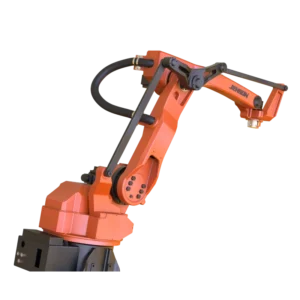
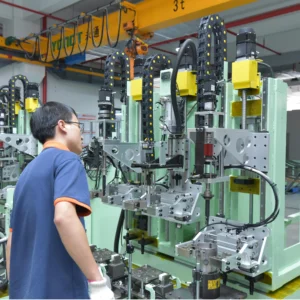
Industrial robot arms are the cornerstone of modern automation, powering everything from automotive assembly lines to precision electronics manufacturing. These sophisticated machines combine mechanical ingenuity with advanced engineering to deliver unmatched speed, accuracy, and reliability. This guide breaks down the key components and subsystems that enable robotic arms to perform complex tasks with consistency and efficiency.

Base and Structural Frame
The base is the foundation of any robotic arm and provides stability by anchoring the entire system. Constructed from robust materials such as cast iron, aluminium, or steel, it is designed to withstand dynamic loads and vibrations during operation.
Design Considerations
• Load-bearing capacity: It supports the weight of the arm, tooling, and payload.
• Mounting flexibility: Configurations vary (floor-standing, ceiling-mounted, or wall-mounted) based on workspace constraints.
• Materials: Lightweight alloys (e.g., aluminium) reduce inertia for faster movements, while heavy-duty steel ensures durability in demanding environments.
Joints and Actuators
The joints (or “axes”) of a robot arm are analogous to the “muscles” of a human arm, determining its range of motion. The actuators, which are the motors powering these joints, determine speed, torque, and precision.
Different Types of Joints
• Revolute joints: The term ‘rotary motion’ refers to movements such as elbow or wrist rotation.
• Prismatic Joints: Linear motion, such as telescoping arm extensions.
Actuator Technologies
• Electric Motors: High-precision servo motors are now the dominant technology in modern arms, offering programmable torque and velocity.
• Hydraulic and pneumatic systems. This is a rare occurrence in the industrial arms sector due to the slower response times and increased maintenance demands of the product.
Links and Kinematic Chain
Links are rigid segments that connect joints. Collectively, they form the kinematic chain, like the arm’s “skeleton”. The design of the arm dictates its reach, flexibility, and workspace geometry.
Kinematic Configurations
• Serial Manipulators: In the majority of cases, such as 6-axis arms, links form a chain that extends from the base to the end-effector.
• Parallel Manipulators: This results in fewer joints, but the increased stiffness, such as delta robots for pick-and-place, makes up for this.
Materials Required
Lightweight composites (carbon fibre) are used to minimise inertia, while steel is employed to ensure structural integrity.
End-Effector (Tooling)
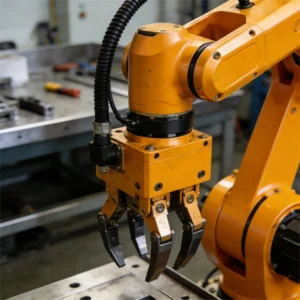
The end-effector is the specialised tool attached to the wrist of the robot arm, designed for specific tasks.
Common Types
• Grippers: Pneumatic or electric clamps for picking up and moving objects.
• Welding torches: Used for precision welding in automotive or construction.
• Suction cups: For handling glass, electronics, or irregularly shaped parts.
• Machine tending tools: Automated loading and unloading of CNC machines.
• Customisation: Often custom-designed for unique applications, such as medical suturing or food packaging.
Sensors and Feedback Systems
Sensors provide real-time data to ensure accuracy, safety, and adaptability.
Types of Sensors
•Position Encoders: Track joint angles and movements (critical for repeatability).
•Force/Torque Sensors: Measure applied forces (e.g., collaborative robots adjusting grip pressure).
•Vision Systems: Cameras/gauges for object recognition (e.g., quality inspection).
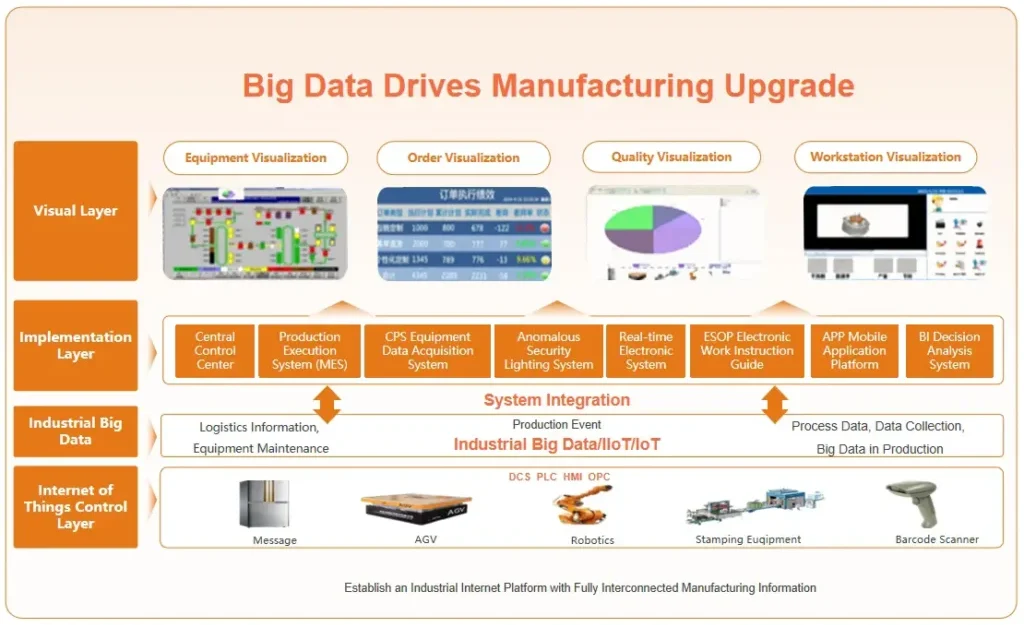
•Feedback Loops: Closed-loop systems (via PLCs or IoT platforms) enable dynamic adjustments during operation.
Control System and Software
The controller acts as the brain, translating commands into precise movements.
Key components
•PLC integration: Programmable Logic Controllers coordinate multi-axis movements.
•Software platforms: Such as ROS (Robot Operating System), KUKA.KRC or proprietary programming software.
Programming Methods
•Teach Pendant: Manual programming via handheld devices.
•Offline Programming: Simulated environments (e.g., RoboDK) for complex workflows.
Safety Features and Compliance
Ensuring safe human-robot collaboration and regulatory compliance.
Safety mechanisms
Light curtains: Detect intrusion into the robot’s workspace.
Emergency stop buttons: Immediate shutdown in hazardous scenarios.
Collision sensors: Prevent damage during accidental contact.
Power Supply and Cooling Systems
Reliable power delivery and thermal management are critical for continuous operation.
Power Sources
•Electricity: Dominant for servo-driven arms (AC/DC drives).
•Hydraulics/Pneumatics: Used in heavy-duty applications (e.g., construction).
Cooling Solutions
Fans, heat sinks, or liquid cooling systems prevent overheating in high-performance arms.
Maintenance and Serviceability
Prolonging lifespan and minimising downtime.
Key Practices
•Scheduled lubrication: Reduces wear on joints and bearings.
•Diagnostic tools: Predictive maintenance via IoT sensors that monitor vibration, temperature, or current draw.
•Modular design: Allows for quick replacement of worn components (e.g., grippers or sensors).
Industry-Specific Applications
Crafting specialized robotic systems demands a nuanced grasp of component engineering. Each industry vertical presents unique operational demands – from precision agriculture’s durability requirements to healthcare’s sterile precision. Understanding component design is vital for tailoring robots to niche sectors:
•Automotive: High-payload arms (e.g., 200+ kg) for welding chassis and painting.
•Electronics: Compact SCARA robots for PCB assembly (micron-level precision).
•Healthcare: Collaborative arms with force-sensing for surgical procedures.
•Food Processing: Stainless-steel arms with hygienic coatings for hygiene-critical tasks.
The Takeaway
Industrial robot arms are marvels of engineering, combining mechanical precision, computational intelligence, and adaptive design. As automation evolves, staying informed about emerging technologies such as articulated robots, cobots, and AI integration will be key to maintaining competitiveness in an increasingly automated world.